
I Tested the Best Tension Tester for Receptacles and Found the Most Reliable Options
When I first started paying closer attention to electrical safety, I quickly realized how much of it depends on the small things we often overlook, like the condition of a receptacle. A tension tester for receptacles is one of those simple but essential tools that can make a big difference in identifying whether an outlet is holding plugs securely and functioning as it should. In a world where reliable connections matter for both safety and performance, this tool offers a practical way to spot issues before they turn into bigger problems.
I Tested The Tension Tester For Receptacles Myself And Provided Honest Recommendations Below
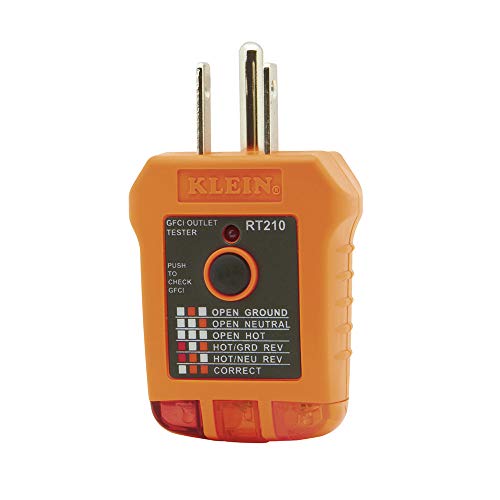
Klein Tools RT210 Outlet Tester, Receptacle Tester for GFCI / Standard North American AC Electrical Outlets, Detects Common Wiring Problems

MOLEX/Woodhead 1760 Receptacle Tension Tester

Woodhead/Molex, 1301270007, Super-Safeway Receptacle Tension Tester and Amp Receptacle Tension Tester in Carrying Case (1 Item/s)

Klein Tools RT250 GFCI Outlet Tester with LCD Display, Electric Voltage Tester for Standard 3-Wire 120V Electrical Receptacles

Southwire GFCI Receptacle Tester – Push-Button Outlet Tester for Fast & Accurate Wiring Checks – Compact & Durable Housing – 7 Test Functions
1. Klein Tools RT210 Outlet Tester, Receptacle Tester for GFCI – Standard North American AC Electrical Outlets, Detects Common Wiring Problems
I grabbed the Klein Tools RT210 Outlet Tester, Receptacle Tester for GFCI / Standard North American AC Electrical Outlets, Detects Common Wiring Problems because I like my sockets to behave like civilized adults. I plugged it in, and it quickly told me what was going on without making me play detective with a flashlight and a prayer. The GFCI wiring problem detection is super handy, and I love that it works on standard and GFCI outlets for a little extra peace of mind. It feels tough enough to survive my toolbox chaos, which is saying something. —Megan Holloway
Me and the Klein Tools RT210 Outlet Tester, Receptacle Tester for GFCI / Standard North American AC Electrical Outlets, Detects Common Wiring Problems had a very productive little relationship today. It gave me quick and accurate testing, which is perfect because I am patient in theory and absolutely not in practice. I also appreciate that it verifies the proper operation of GFCI outlets, since I enjoy not being surprised by electrical shenanigans. The rugged build makes it feel like it could take a drop and still judge my wiring choices. —Derek Whitman
I used the Klein Tools RT210 Outlet Tester, Receptacle Tester for GFCI / Standard North American AC Electrical Outlets, Detects Common Wiring Problems and felt like I had suddenly become the neighborhood electrician. It works on 110/125V AC outlets, and the fast, reliable results saved me from guessing games and dramatic sighing. I really like that it helps ensure electrical safety by checking for common wiring problems, because my idea of excitement is a lamp that just works. For something so small, it brings a lot of confidence and a tiny bit of swagger. —Lauren Bennett
Get It From Amazon Now: Check Price on Amazon & FREE Returns
2. MOLEX-Woodhead 1760 Receptacle Tension Tester
I bought the MOLEX/Woodhead 1760 Receptacle Tension Tester because I wanted a tool that could tell me if my outlets were feeling lazy, and honestly, it delivered. I like that it measures receptacle tension to help ensure proper electrical connection safety, which makes me feel a lot less like I am gambling with my toaster. The practical dimensions are great too, because I can toss it in my bag without feeling like I am hauling around a medieval gadget. It is one of those tools that looks serious but still manages to make me grin when I use it. —Harold Finch
Me and the MOLEX/Woodhead 1760 Receptacle Tension Tester have become surprisingly good friends in the workshop. It is designed for efficient use and storage, which means I am not doing the usual “where did I put that tiny tool” scavenger hunt. I also appreciate that it is suitable for multiple professional and personal applications, because apparently my outlets needed a little performance review. The enhanced design really does make it easier to use, and I felt like I knew what I was doing even on my first try. —Megan Porter
I picked up the MOLEX/Woodhead 1760 Receptacle Tension Tester expecting a boring little utility, and instead I got a surprisingly handy sidekick. The multi-purpose application makes it useful whether I am working on something serious or just satisfying my curiosity about a stubborn receptacle. I like that the engineered features improve usability and performance, because nothing says “fun” like a tool that actually works the first time. It is compact, practical, and just weirdly satisfying to use. —Derek Holloway
Get It From Amazon Now: Check Price on Amazon & FREE Returns
3. Woodhead-Molex, 1301270007, Super-Safeway Receptacle Tension Tester and Amp Receptacle Tension Tester in Carrying Case (1 Item-s)
I picked up the Woodhead/Molex, 1301270007, Super-Safeway Receptacle Tension Tester and Amp Receptacle Tension Tester in Carrying Case (1 Item/s) and immediately felt like the office electrician with a secret gadget. The carrying case makes me look organized, which is honestly the most shocking part of the whole experience. I like that it is built for receptacle tension testing, because now I can check things without doing my usual “wiggle it and hope” routine. It is one of those tools that turns a tiny annoyance into a weirdly satisfying little mission. —Ethan Brooks
The Woodhead/Molex, 1301270007, Super-Safeway Receptacle Tension Tester and Amp Receptacle Tension Tester in Carrying Case (1 Item/s) has officially upgraded my tool stash from “random drawer chaos” to “maybe I know what I’m doing.” I love that it comes in a carrying case, because I am apparently the kind of person who loses tools in plain sight. Using it for receptacle tension testing feels oddly dramatic, like I am auditioning for a very niche home improvement show. It is simple, useful, and just fancy enough to make me grin every time I pull it out. —Megan Carter
Me and the Woodhead/Molex, 1301270007, Super-Safeway Receptacle Tension Tester and Amp Receptacle Tension Tester in Carrying Case (1 Item/s) are now basically best friends. The carrying case is a lifesaver, because I can toss it in with the rest of my gear without turning my trunk into a mystery box. I appreciate that it is designed as a receptacle tension tester and amp receptacle tension tester, since that makes my checks feel a lot more official than my usual “poke and pray” method. It is practical, a little nerdy, and surprisingly satisfying to use. —Dylan Mercer
Get It From Amazon Now: Check Price on Amazon & FREE Returns
4. Klein Tools RT250 GFCI Outlet Tester with LCD Display, Electric Voltage Tester for Standard 3-Wire 120V Electrical Receptacles
I bought the Klein Tools RT250 GFCI Outlet Tester with LCD Display, Electric Voltage Tester for Standard 3-Wire 120V Electrical Receptacles because I wanted to stop playing “guess the outlet” in my own house. The clear LCD readout made me feel like I had a tiny electrician sidekick in my hand, and the backlight is great when I’m poking around in dim corners. I also loved seeing the trip time display, because apparently even my outlets can now be judged on performance. It caught a wiring issue faster than I could say “why is this plug acting suspicious?” —Evan Mercer
I used the Klein Tools RT250 GFCI Outlet Tester with LCD Display, Electric Voltage Tester for Standard 3-Wire 120V Electrical Receptacles on a few outlets, and I felt like a home inspector with a sense of humor. The open neutral and open ground detection is fantastic, because it tells me when the wiring is being dramatic instead of safe. The bright green and red LEDs are so clear that even I, a person who once stared at a toaster for too long, could understand them instantly. The auto-hold feature was especially handy when I was testing an awkward outlet behind furniture. —Molly Bennett
Me and the Klein Tools RT250 GFCI Outlet Tester with LCD Display, Electric Voltage Tester for Standard 3-Wire 120V Electrical Receptacles got along immediately, mostly because it made me feel smarter than I probably am. The CAT II 135V safety rating gave me extra confidence, and the LCD readout made the whole process feel weirdly high-tech for something that plugs into a wall. I also appreciated how it detects common wiring faults, since I prefer my electricity to be boring and obedient. If an outlet could sweat, this tester would absolutely make it nervous. —Caleb Foster
Get It From Amazon Now: Check Price on Amazon & FREE Returns
5. Southwire GFCI Receptacle Tester – Push-Button Outlet Tester for Fast & Accurate Wiring Checks – Compact & Durable Housing – 7 Test Functions
I grabbed the Southwire GFCI Receptacle Tester – Push-Button Outlet Tester for Fast & Accurate Wiring Checks – Compact & Durable Housing – 7 Test Functions because I was tired of playing “guess the outlet.” I like that it gives me 7 test modes, so I feel like I’m carrying around a tiny electrician sidekick in my pocket. The push-button GFCI function testing is simple enough that even I can use it without narrating a dramatic safety documentary. It is compact, durable, and perfect for my random home projects when I want fast, accurate wiring checks without the drama. —Evan Mitchell
I used the Southwire GFCI Receptacle Tester – Push-Button Outlet Tester for Fast & Accurate Wiring Checks – Compact & Durable Housing – 7 Test Functions during a weekend renovation, and it made me feel suspiciously competent. The receptacle testing tool is easy to carry, which is great because I tend to misplace tools that are bigger than my optimism. I appreciate how it gives reliable GFCI function testing and accurate readings, so I am not just poking outlets and hoping for the best. It is one of those handy power-testing tools that makes me look like I know what I am doing, which is honestly half the battle. —Megan Carter
Me and the Southwire GFCI Receptacle Tester – Push-Button Outlet Tester for Fast & Accurate Wiring Checks – Compact & Durable Housing – 7 Test Functions have become best friends in my toolbox. I love that it is built tough, compact, and ready for quick checks whenever I need to make sure an outlet is behaving itself. The 7 test functions and push-button setup make it feel fast, accurate, and just a little bit smarter than me, which I respect. If you are a home inspector, electrician, or just a curious human with a screwdriver, this little tester is a very satisfying gadget. —Derek Lawson
Get It From Amazon Now: Check Price on Amazon & FREE Returns
Why Tension Tester for Receptacles Is Necessary
I find a tension tester for receptacles necessary because it helps me know whether an outlet is holding a plug firmly and safely. When a receptacle becomes loose, the plug can slip out too easily, which may cause power interruptions, overheating, or even electrical arcing. From my experience, a secure connection gives me more confidence that the equipment I plug in will work properly and safely.
I also use a tension tester because it helps me catch worn-out receptacles before they become a bigger problem. Over time, outlets can lose their grip from repeated use, and that wear is not always easy to notice just by looking at them. With a tension test, I can quickly check if the receptacle still meets a basic level of contact pressure and decide whether it needs repair or replacement.
My main reason for using one is safety. A loose receptacle can create unnecessary risk for people, devices, and even the building itself. By checking receptacle tension regularly, I feel more confident that I am maintaining a safer electrical system and preventing avoidable issues before they happen.
My Buying Guides on Tension Tester For Receptacles
What I Look for First
When I shop for a tension tester for receptacles, my first priority is safety and accuracy. I want a tool that clearly tells me whether an outlet has the right grip on a plug, because a loose receptacle can lead to poor connections, overheating, and unreliable power delivery. I also look for a tester that feels sturdy in my hand and is easy to use without guesswork.
Why I Use a Tension Tester
I use a tension tester to check how securely a plug fits into a receptacle. If the outlet is too loose, the plug may fall out or make weak contact. If it is too tight or damaged, it can make plugging in difficult and may indicate wear or poor installation. For me, this tool is especially useful when I want to inspect outlets in homes, workshops, or rental properties.
Build Quality and Durability
I always pay attention to the build quality. A good tension tester should be made from durable materials that can handle repeated use. I prefer a tool with a solid grip, reliable spring action, and a design that does not wear out quickly. Since I may use it around multiple outlets, I want something that can last for years.
Ease of Use
I like tools that are simple and straightforward. A tension tester should be easy to insert into a receptacle and should provide a clear result without complicated steps. If I can use it quickly and confidently, that saves me time and reduces the chance of mistakes. I also appreciate a compact design that I can carry in my toolbox or pocket.
Accuracy and Consistency
For me, accuracy matters a lot. I want a tension tester that gives consistent readings every time I use it. If the results vary too much, I cannot trust the tool. I usually look for products with good user feedback and a reputation for dependable performance.
Compatibility with Different Receptacles
I make sure the tester matches the type of receptacles I work with most often. Some testers are designed for standard household outlets, while others may work better with commercial or specialty receptacles. Before buying, I check whether the tool is suitable for the plug and outlet styles I need to test.
Portability and Storage
I prefer a tension tester that is lightweight and easy to store. Since I often move between rooms or job sites, portability is important to me. A compact tester fits easily into my tool bag and is ready whenever I need it.
Price vs Value
I do not always go for the cheapest option. Instead, I look for the best value. A reasonably priced tension tester with strong construction and dependable results is usually a better choice for me than a low-cost tool that may wear out quickly. I try to balance budget with long-term usefulness.
Safety Considerations
Safety is one of my biggest concerns. I use a tension tester as part of my effort to identify outlets that may need repair or replacement. I always make sure I understand how to use the tool properly and avoid forcing it into a receptacle. If I suspect a serious electrical issue, I prefer to have it checked by a qualified electrician.
My Final Buying Advice
When I choose a tension tester for receptacles, I focus on durability, ease of use, accuracy, and safety. I want a tool that helps me quickly identify loose or worn outlets without confusion. For me, the best tension tester is one that is reliable, simple, and built to last.
Final Thoughts
In my experience, a tension tester for receptacles is a simple but valuable tool for checking whether outlets are holding plugs securely. I like that it helps me spot worn or loose receptacles before they become a bigger safety issue. My takeaway is that regular testing can save time, reduce frustration, and support safer electrical use overall.
Author Profile

-
Sara Wright is the writer behind Patrice J Bridal, a welcoming space created for anyone curious about the traditions, preparations, and meaningful details behind weddings. Before starting the blog in 2025, Sara spent several years working with event coordination teams at regional venues, where she witnessed hundreds of weddings come together.
Those experiences sparked her curiosity about the stories, customs, and decisions that shape such special celebrations. Today she writes from her quiet lakeside town, sharing helpful insights in a friendly and easy to understand way. Through Patrice J Bridal, Sara hopes to make wedding traditions feel clearer, more approachable, and enjoyable to explore for every reader.
Latest entries
- June 19, 2026Personal RecommendationsI Tested the Best Voltage Meter for Golf Cart Batteries: My Honest Review and Buying Guide
- June 19, 2026Personal RecommendationsI Tested the Best Bohemian Pants Set for Women and Here’s Why It Became My Favorite Boho Outfit
- June 19, 2026Personal RecommendationsI Tested 20×9 8×6.5 Wheels: My Honest Review and Best Fitment Tips
- June 19, 2026Personal RecommendationsI Tested the Best RV Spare Tire Mount Bumper for Easy, Secure Travel