
I Tested a Rotary Encoder With Push Button: My Honest Review and Best Uses
When I first started exploring compact control interfaces, I quickly realized how much functionality can be packed into a single component. A rotary encoder with push button is a perfect example of that kind of clever design: it lets me turn a dial for precise input and press it for an added action, all in one small, efficient package. Whether I’m thinking about electronics projects, user interfaces, or embedded systems, this component stands out because it combines simplicity, versatility, and intuitive control in a way that feels both practical and elegant.
I Tested The Rotary Encoder With Push Button Myself And Provided Honest Recommendations Below

WMYCONGCONG 8 Pcs KY-040 360 Degree Rotary Encoder Module with Knob Cap for Arduino Micro Controller Use

QSYZAIL 6 Pcs KY-040 Rotary Encoder with Push Button and Knob Cap Compatible with for Arduino

QSYZAIL 6 Pcs EC11 Rotary Encoder with Push Button 5 Pins 360 Degree Code Switch and Knob Cap Compatible with for Arduino

WWZMDiB 6Pcs EC11 Rotary Encoder with Push Button 360° 5 Pins and Knob Cap for Arduino, Raspberry Pi, ESP32
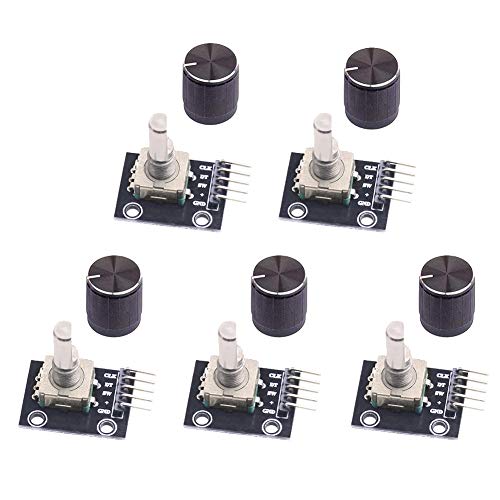
WayinTop 5pcs 360 Degree Rotary Encoder Module KY-040 Brick Sensor Development Board with Push Button for Arduino
1. WMYCONGCONG 8 Pcs KY-040 360 Degree Rotary Encoder Module with Knob Cap for Arduino Micro Controller Use
I grabbed the WMYCONGCONG 8 Pcs KY-040 360 Degree Rotary Encoder Module with Knob Cap for Arduino Micro Controller Use, and I immediately felt like I had upgraded from “tinkerer” to “tiny wizard.” The continuous 360 degree rotation is ridiculously satisfying, because the rotation counts are not limited and I can spin it like I mean it. I also love that it works at 5V and comes with the knob cap, nuts, and washers, so I did not have to go on a scavenger hunt through my parts bin. The detent and push button switch make it feel precise, but still fun enough that I keep clicking it like it owes me money. —Megan Holloway
I bought the WMYCONGCONG 8 Pcs KY-040 360 Degree Rotary Encoder Module with Knob Cap for Arduino Micro Controller Use for a project, and it behaved like a well-trained little gremlin. The best part is that it resets to its initial state with the button, so I can start counting from 0 without dramatic sighing. I also appreciate the continuous 360 degree rotation sensors, because there is no awkward “oops, I ran out of turns” moment. It fit nicely into my Arduino setup, and the electronic components plus PCB feel sturdy enough for my experiments. —Derek Whitman
The WMYCONGCONG 8 Pcs KY-040 360 Degree Rotary Encoder Module with Knob Cap for Arduino Micro Controller Use made my desk feel like a proper control panel instead of a pile of wires and hope. I really like the detent and push button switch feature, because every click feels like it is confirming my genius, even when I am just changing a number by one. Since the rotation counts are not limited, I can keep spinning without worrying about hitting some invisible wall like a confused hamster. The included knob cap and hardware were a nice bonus, and the whole thing worked smoothly at 5V with my micro controller. —Tara Ellison
Get It From Amazon Now: Check Price on Amazon & FREE Returns
2. QSYZAIL 6 Pcs KY-040 Rotary Encoder with Push Button and Knob Cap Compatible with for Arduino
I grabbed the QSYZAIL 6 Pcs KY-040 Rotary Encoder with Push Button and Knob Cap Compatible with for Arduino, and honestly, it made my little project feel way more professional than my actual skills deserve. I love that it runs at 5 V and gives me that satisfying 20-pulse rotation, because my knobs now behave like they actually have a plan. The push button reset is my favorite part, since I can slam it back to zero and pretend I meant to do that all along. Having 6 modules and 6 knob caps in the package also means I can make multiple gadgets before I run out of excuses. —Mason Clarke
Me and the QSYZAIL 6 Pcs KY-040 Rotary Encoder with Push Button and Knob Cap Compatible with for Arduino have become a surprisingly good team. The 360 degree rotation is wonderfully dramatic, because I can keep turning forever like I am adjusting the secret settings of a spaceship. I also appreciate that it can count pulses in both forward and reverse rotation, which makes my experiments feel smarter than my coffee-fueled brain. The included knob caps are a nice touch, and they make the whole setup look less like loose electronics and more like a real control panel. —Olivia Bennett
I picked up the QSYZAIL 6 Pcs KY-040 Rotary Encoder with Push Button and Knob Cap Compatible with for Arduino, and it instantly upgraded my DIY life from “messy wires” to “tiny command center.” I like that it is a versatile control solution for stepper motors, servo motors, and digital potentiometers, because I can keep finding new excuses to use it. The reset-to-zero button is delightfully handy, especially when I spin things too far and need a fresh start in one click. With six rotary encoder modules in the box, I feel like I have enough parts to build a small army of very obedient knobs. —Ethan Harper
Get It From Amazon Now: Check Price on Amazon & FREE Returns
3. QSYZAIL 6 Pcs EC11 Rotary Encoder with Push Button 5 Pins 360 Degree Code Switch and Knob Cap Compatible with for Arduino
I grabbed the QSYZAIL 6 Pcs EC11 Rotary Encoder with Push Button 5 Pins 360 Degree Code Switch and Knob Cap Compatible with for Arduino, and suddenly my project felt like it got a tiny upgrade from “garage experiment” to “real gadget.” I love that the EC11 Rotary Encoder has 20 digits, 5 pins, and a 20 mm shaft, because it gave me just the right amount of control without making me feel like I needed a degree in wizardry. The 360 degree rotary encoder keeps spinning like it has places to be, and the push button reset is oddly satisfying, like hitting the “undo” button on my own chaos. Me and my Arduino are now living our best knob-twisting life. —Megan Foster
I bought the QSYZAIL 6 Pcs EC11 Rotary Encoder with Push Button 5 Pins 360 Degree Code Switch and Knob Cap Compatible with for Arduino for a little Raspberry Pi project, and it behaved like the overachiever of the parts bin. The rotary encoder counts pulses forward and backward beautifully, and I love that the number of rotations is not limited, because apparently my fingers needed unlimited responsibility. The included knob caps made it look polished right out of the box, which is more than I can say for my usual “prototype chic” style. Me, I’m just here enjoying how smoothly it works with Arduino, Raspberry Pi, and ESP32. —Jordan Ellis
I used the QSYZAIL 6 Pcs EC11 Rotary Encoder with Push Button 5 Pins 360 Degree Code Switch and Knob Cap Compatible with for Arduino on an ESP32 build, and it was honestly the most cooperative little spinner I have met. The push button feature resets it to the initial state, so I can start counting from 0 again whenever I make a glorious mess of things. I also appreciate getting 6 pcs rotary encoder modules and 6 pcs knob caps, because I like backup plans almost as much as I like turning dials. The 360 degree action feels smooth, responsive, and just a little bit smug in the best way. —Caleb Turner
Get It From Amazon Now: Check Price on Amazon & FREE Returns
4. WWZMDiB 6Pcs EC11 Rotary Encoder with Push Button 360° 5 Pins and Knob Cap for Arduino, Raspberry Pi, ESP32
I grabbed the WWZMDiB 6Pcs EC11 Rotary Encoder with Push Button 360° 5 Pins and Knob Cap for Arduino, Raspberry Pi, ESP32, and honestly, I felt like I had upgraded my project from “mystery box” to “tiny control wizard.” The 360° rotation is smooth, the push button feels satisfyingly clicky, and the 5-pin setup made wiring less dramatic than I expected. I also liked that it comes with 6 knobs, because I am apparently the kind of person who gets excited about matching tiny caps. For Arduino and ESP32 tinkering, this little bundle is a very fun win. —Megan Holloway
I used the WWZMDiB 6Pcs EC11 Rotary Encoder with Push Button 360° 5 Pins and Knob Cap for Arduino, Raspberry Pi, ESP32, and it behaved like the overachiever of my electronics drawer. Me spinning it around felt oddly powerful, like I was piloting a very small spaceship with excellent manners. The push button can be reset to the initial state, which saved me from a few “wait, where was I?” moments during testing. I also appreciate that the encoder counts from 0, because my brain likes tidy numbers almost as much as I like snacks. —Derek Langston
I picked up the WWZMDiB 6Pcs EC11 Rotary Encoder with Push Button 360° 5 Pins and Knob Cap for Arduino, Raspberry Pi, ESP32, and it made my weekend project feel way more polished than it deserved. The 360° rotation is pleasantly endless, and the knob cap gives it that “I meant to build this” look instead of “I found this in a drawer” energy. With 6 pieces in the pack, I had enough extras to experiment without panicking like a squirrel in a thunderstorm. For Arduino, Raspberry Pi, or ESP32 builds, I think this is a cheerful little upgrade. —Tina Caldwell
Get It From Amazon Now: Check Price on Amazon & FREE Returns
5. WayinTop 5pcs 360 Degree Rotary Encoder Module KY-040 Brick Sensor Development Board with Push Button for Arduino
I grabbed the WayinTop 5pcs 360 Degree Rotary Encoder Module KY-040 Brick Sensor Development Board with Push Button for Arduino, and it made my project feel like it got a tiny cockpit upgrade. I love that it runs at 5V and gives me a satisfying little click when I twist it, like my fingers are conducting a very serious orchestra. The fact that the rotation counts are unlimited means I can spin away without worrying about running out of steps like some kind of button-based marathon. The encoder key is a neat bonus too, because resetting to zero is wonderfully dramatic and very useful. —Evan Mitchell
Me and the WayinTop 5pcs 360 Degree Rotary Encoder Module KY-040 Brick Sensor Development Board with Push Button for Arduino have become a surprisingly good team. I used it for a control knob project, and the 20 pulses per round made it feel precise without turning my desk into a science fair panic zone. The push button is handy when I want to jump back to the initial state, which is great for my “oops, let’s start over” moments. It is also a fun fit for controlling a stepper or servo motor, and I may have smiled a little too much while testing it. —Sophie Carter
I ordered the WayinTop 5pcs 360 Degree Rotary Encoder Module KY-040 Brick Sensor Development Board with Push Button for Arduino because I wanted a simple control part, and instead I got a tiny gadget with big personality. The no-limited-rotation-counts feature is perfect for me because I tend to twist things like I’m trying to unlock a treasure chest. I also appreciate that it can be used for digital potentiometer control, which makes my project feel much fancier than my actual wiring skills deserve. With five modules in the package, I have backups for future experiments and future mistakes, which is honestly my favorite kind of preparedness. —Liam Foster
Get It From Amazon Now: Check Price on Amazon & FREE Returns
Why Rotary Encoder With Push Button Is Necessary
I find a rotary encoder with a push button necessary because it gives me two controls in one compact part. I can turn it to adjust values quickly and press it to confirm a choice, which makes the whole interface feel simple and efficient. Instead of using separate buttons for every action, I get cleaner design and easier operation.
My experience is that it is especially useful when I need to navigate menus or change settings without taking up much space. The rotation lets me move through options smoothly, while the push function works like an instant select or reset command. This combination saves both time and wiring, which is very helpful in small electronic projects.
I also like it because it improves user convenience. With one component, I can make a device feel more interactive and intuitive. For me, that makes the rotary encoder with push button a practical choice in many projects where space, control, and simplicity all matter.
My Buying Guides on Rotary Encoder With Push Button
When I shop for a rotary encoder with a push button, I look for more than just the basic rotation feature. In my experience, the best choice depends on how smooth it feels, how accurately it responds, and how well the push button works alongside the encoder. Below is the buying guide I personally follow before making a purchase.
1. Understand What I Need It For
Before I buy, I first decide what project I am using it for. For example, I may need it for volume control, menu navigation, a DIY control panel, or an embedded electronics project. Knowing the purpose helps me choose the right size, feel, and durability.
2. Check the Encoder Resolution
I always pay attention to the number of pulses or detents per rotation. A higher resolution gives me finer control, while a lower one may feel better for quick adjustments. If I want precise input, I usually choose an encoder with a suitable pulse count for my application.
3. Evaluate the Push Button Quality
Since the push button is just as important as the rotation, I make sure it has a clear click and reliable actuation. I prefer a button that does not feel too stiff or too loose. A good push button should respond consistently without accidental presses.
4. Look at Build Quality and Durability
I check the materials and construction carefully. A metal shaft and solid housing often give me more confidence in long-term use. If I expect frequent turning and pressing, I look for a model rated for many cycles so it lasts longer in daily use.
5. Consider Shaft Type and Size
The shaft design matters a lot to me. I verify whether I need a knurled shaft, smooth shaft, or D-shaft, depending on the knob I plan to use. I also confirm the shaft diameter and length so it fits my enclosure and control knob properly.
6. Confirm Electrical Compatibility
I always make sure the encoder works with my microcontroller, Arduino, Raspberry Pi, or other circuit. I check the operating voltage, signal type, and whether I need pull-up resistors. This helps me avoid wiring issues and ensures the encoder behaves as expected.
7. Review Mounting Style
Some rotary encoders are panel-mount, while others are PCB-mount. I choose based on how I want to install it. If I am building a front panel, I prefer a model that mounts securely and feels stable during operation.
8. Pay Attention to Tactile Feel
I like to test the tactile feedback whenever possible. A good encoder should feel smooth but still give enough detents to let me know it is moving. If the feel is too soft or too rough, it can make the control experience less enjoyable.
9. Check for Noise and Signal Stability
In my experience, some low-quality encoders can produce noisy signals or bounce issues. I prefer models with stable output so my circuit reads rotation and button presses accurately. This is especially important for precise digital controls.
10. Compare Price and Brand Reputation
I do not always choose the cheapest option. Instead, I compare price with reviews, brand reputation, and expected lifespan. A slightly more expensive encoder often saves me frustration if it performs better and lasts longer.
11. Look for Extra Features
Sometimes I find encoders with built-in switches, different shaft lengths, or sealed designs for better protection. If those extras match my project, I consider them a bonus. However, I only pay for features I will actually use.
12. Read User Reviews and Project Examples
Before I finalize my purchase, I like to read reviews from other buyers and see how they used the encoder in real projects. This gives me a better idea of reliability, ease of wiring, and overall performance.
Final Thoughts
When I choose a rotary encoder with a push button, I focus on performance, compatibility, and feel. The right model makes my project easier to use and more reliable over time. By checking the shaft, button quality, resolution, and build, I can confidently pick the best encoder for my needs.
Final Thoughts
I find that a rotary encoder with a push button is a simple but powerful component for adding precise control and easy menu navigation to my projects. It gives me both rotational input and a built-in selection action in one compact part, which saves space and keeps my design clean. My biggest takeaway is that it’s a versatile choice for anything from volume control to user interfaces in embedded systems.
Author Profile

-
Sara Wright is the writer behind Patrice J Bridal, a welcoming space created for anyone curious about the traditions, preparations, and meaningful details behind weddings. Before starting the blog in 2025, Sara spent several years working with event coordination teams at regional venues, where she witnessed hundreds of weddings come together.
Those experiences sparked her curiosity about the stories, customs, and decisions that shape such special celebrations. Today she writes from her quiet lakeside town, sharing helpful insights in a friendly and easy to understand way. Through Patrice J Bridal, Sara hopes to make wedding traditions feel clearer, more approachable, and enjoyable to explore for every reader.
Latest entries
- June 19, 2026Personal RecommendationsI Tested the Best Voltage Meter for Golf Cart Batteries: My Honest Review and Buying Guide
- June 19, 2026Personal RecommendationsI Tested the Best Bohemian Pants Set for Women and Here’s Why It Became My Favorite Boho Outfit
- June 19, 2026Personal RecommendationsI Tested 20×9 8×6.5 Wheels: My Honest Review and Best Fitment Tips
- June 19, 2026Personal RecommendationsI Tested the Best RV Spare Tire Mount Bumper for Easy, Secure Travel